
← Blog · 23 June 2026
Federal Battery Rebate Overhauled as Tasmanian Network Costs and Major Hydro Deal Signal Shifting Energy Landscape
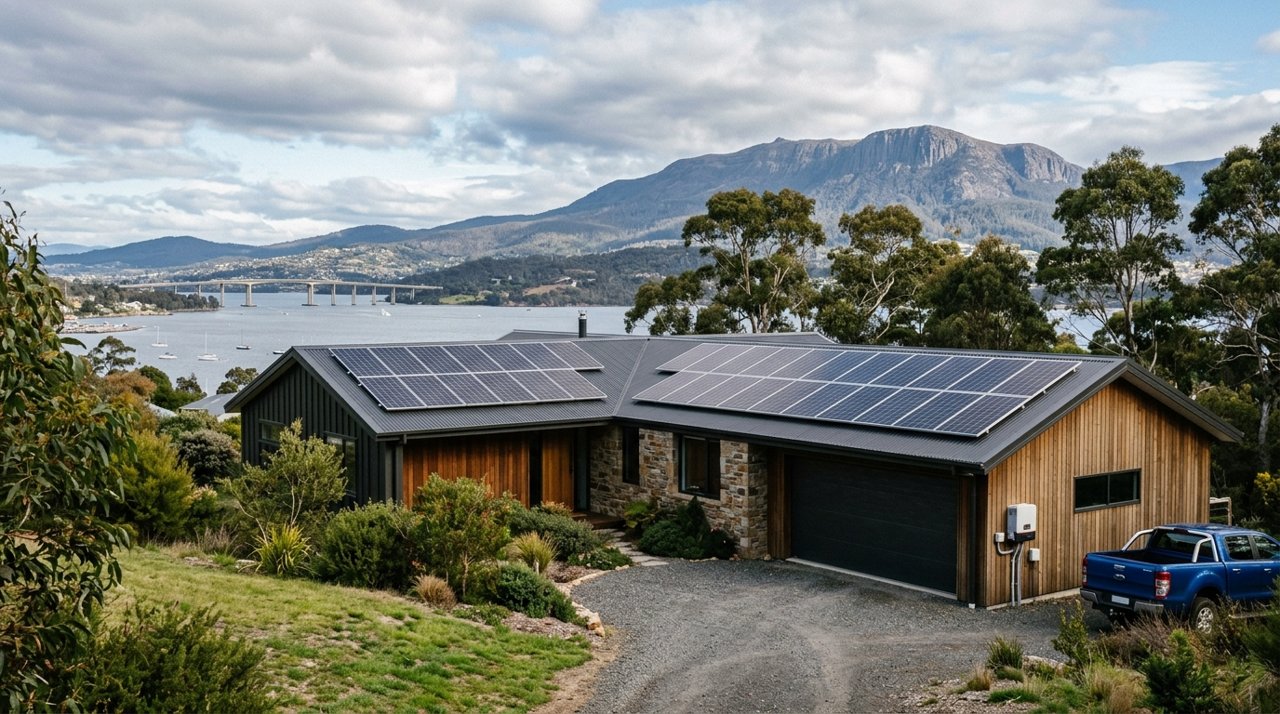
A significant overhaul of the federal home battery subsidy took effect in recent weeks, altering the financial equation for households installing energy storage, while in Tasmania, upcoming electricity price rises and a major new industrial energy deal are reshaping the local outlook. These developments coincide with a broader technology shift towards more efficient solar panels, impacting decisions for Tasmanians considering investing in solar energy.
The most immediate change for homeowners is the restructuring of the national Cheaper Home Batteries Program, which took effect on May 1, 2026. The Department of Climate Change, Energy, the Environment and Water confirmed the program, which provides an upfront discount on new batteries, has moved from a simple flat-rate incentive to a tiered system. Under the new rules administered by the Clean Energy Regulator, the full subsidy rate applies only to the first 14 kilowatt-hours (kWh) of a battery’s usable capacity. For capacity between 14kWh and 28kWh, the incentive is reduced to 60% of the full rate, and it drops to 15% for capacity between 28kWh and 50kWh. The federal government stated this change encourages “right-sized” battery installations and ensures the program’s expanded $7.2 billion budget can support its goal of two million household batteries by 2030. For a Tasmanian homeowner, this means the subsidy is now optimised for typical home batteries, with diminishing returns for very large systems.
Locally, Tasmanians are facing changes to power bills from July 1, 2026. In a pricing proposal submitted to the Australian Energy Regulator on March 31, TasNetworks flagged a 6.5 per cent increase in the network component of electricity bills for a typical residential customer. The network operator attributed the rise to increased costs for using the transmission network, including revenue recovery for early works on the North West Transmission Development. While the Tasmanian Economic Regulator has not yet announced the final retail electricity prices or the new solar feed-in tariff for 2026-27, which Aurora Energy’s website confirms will be reset on July 1, this network price hike is a primary driver of the final bill.
In early June, news emerged of a significant new use for Tasmania’s hydroelectricity. State-owned retailer Aurora Energy confirmed it had signed a deal to supply 104 megawatts of power to Firmus Technology, an AI and data centre company, as reported by various media outlets. During budget estimates, Tasmania’s Minister for Energy noted that Firmus’s total planned consumption could reach 400 megawatts, which would make it the single largest energy user in the state. The deal has sparked public discussion about the allocation of the state’s finite hydro resources at a time of increasing demand.
On the technology front, the solar panel market in 2026 is seeing a decisive shift. Industry analysts report that TOPCon (Tunnel Oxide Passivated Contact) cell technology is rapidly becoming the new standard for residential installations, displacing the older PERC (Passivated Emitter and Rear Cell) technology. TOPCon panels offer higher efficiency and better performance in high-temperature conditions, which is increasingly relevant for maximising output.
These state and federal changes are occurring within a national context outlined by the Australian Energy Market Operator (AEMO). While its Draft 2026 Integrated System Plan (ISP) was released late last year, its findings continue to frame the energy transition. AEMO’s draft plan reinforces that consumer-owned resources like rooftop solar and batteries are central to the future grid, and it highlights the essential role of long-duration storage, such as Tasmania’s hydropower, in ensuring reliability for the National Electricity Market.
For Tasmanians, these developments highlight a national shift towards more nuanced battery storage incentives, alongside local network cost pressures and strategic decisions about the future use of the state’s renewable energy resources.
#solargentas #solargen #solargenerationtasmania
Published by Solar Generation Tasmania. General information current as at publication — rebates, tariffs and prices change, so confirm current figures before deciding.
Thinking about solar for your place?
Tell us a little about your home and a local Tasmanian installer will put together a free, no-obligation assessment — system, battery and the rebates you qualify for.
- Honest advice for Tasmanian conditions (Zone 4 sun, hydro grid)
- We apply every rebate you’re eligible for
- Local installers — not a mainland call centre
- SAA-accredited, with degree-qualified owners and 10+ years in tech & solar