
← Blog · 24 June 2026
Net Metering Tasmania: How It Works — Your Bill, Phases and Feed-in Tariff
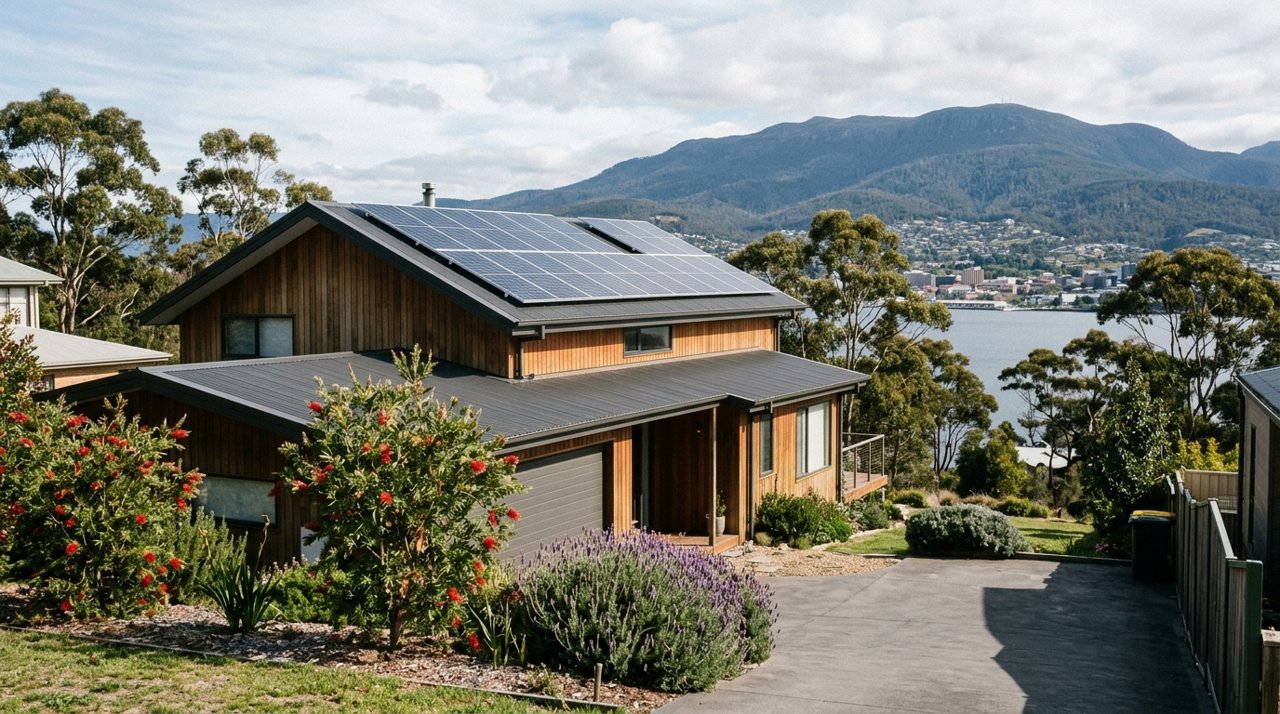
If you’ve just installed solar panels on your Tassie home, or you’re thinking about it, you’ll hear the term “net metering” thrown around a lot. It’s the key to how you get paid for the power you generate and how your electricity bill is calculated. But what does it actually mean for your savings, especially in a place with its own unique power grid and weather like Tasmania?
This guide breaks it down in plain English. We’ll cover how your smart meter works, why the number of phases in your house matters (and why it doesn’t), and how to get the absolute most value out of your solar panels and battery.
What is Net Metering, Anyway?
At its core, net metering is a simple concept. Your home has a smart meter (an import/export meter) that acts like a two-way street counter for electricity.
- It measures electricity you IMPORT from the grid. This happens when your home needs more power than your solar panels are generating, like at night or on a very cloudy day.
- It measures electricity you EXPORT to the grid. This happens when your solar panels produce more power than your home is using, typically in the middle of a sunny day.
At the end of each billing period, your electricity retailer, like Aurora Energy, looks at the net difference. You are billed for the total electricity you imported and credited for the total electricity you exported. The credit you receive for your exports is called a feed-in tariff (FiT).
This process is managed by a modern bidirectional smart meter, which has to be installed when you get solar to measure this two-way flow.
Net vs. Gross Metering: Why Self-Consumption is King
All new solar installations in Tasmania and across Australia use net metering. This is a crucial point.
With net metering, the electricity from your solar panels powers your home first. Any appliances running during the day—the fridge, a heat pump, the washing machine—will automatically use the free solar power before drawing anything from the grid. Only the leftover, surplus power you don’t use gets exported.
This is different from the old gross metering systems that were common a decade ago. Under those schemes, all the solar power you generated was instantly exported to the grid, and you were paid a very high feed-in tariff for it. At the same time, your home would buy back all the electricity it needed from the grid. This made sense when feed-in tariffs were high (sometimes over 60c/kWh), but those days are long gone.
Today, with much lower feed-in tariffs, net metering is far better because it encourages you to use your own solar power. This is called self-consumption, and it’s the smartest way to save money with solar.
The Phase Point: A Tasmanian Multi-Phase Myth Busted
Many larger or older homes in Tasmania have a two-phase or three-phase power supply. This can cause a bit of confusion when it comes to solar. A common worry is: “If my single-phase solar inverter is exporting on Phase A, but my heat pump is importing power on Phase B, will I be charged for the import and get a tiny credit for the export at the same time?”
The answer is a clear no.
Your smart meter is clever. It calculates the net total across all phases combined at any given moment.
Let’s break that down with an example:
- It’s a sunny afternoon.
- Your solar inverter (on Phase A) is exporting 4 kilowatts (kW) of surplus power.
- Your oven (on Phase B) is drawing 1.5 kW from the grid.
- Your lights and TV (on Phase C) are drawing 0.5 kW from the grid.
Even though you are technically importing on two phases and exporting on one, your smart meter sums it all up. It sees a total export of 4 kW and a total import of 2 kW (1.5 + 0.5). The meter records the net result for that instant: a 2 kW export to the grid. You are not billed for importing on phases B and C.
Gotcha: Your inverter’s monitoring app might show you a different story. Some apps display data on a per-phase basis, so you might see a graph showing you are both importing and exporting simultaneously. This can be alarming, but remember, this is not how you are billed. Your power bill is based on the final, netted-off reading from your official utility smart meter.
Why Self-Consumption Still Wins by a Mile
The financial logic of net metering in Tasmania is simple and powerful. Using your own solar power is worth far more than exporting it.
Here’s a look at the typical numbers for 2026-27:
- Price to import 1 kWh of electricity: Roughly 25-29 cents.
- Credit for exporting 1 kWh (the feed-in tariff): 9.276 cents.
Every kilowatt-hour (kWh) of solar energy you use in your own home saves you from buying a 25-29 cent unit of electricity. But if you export that same kWh, you only get a 9.3 cent credit. This means a unit of self-consumed solar is worth about three times more than a unit you export.
This value gap is why maximising your self-consumption is the number one goal for getting a quick payback on your solar investment. Tasmania actually has the highest rate of solar self-consumption in Australia, partly because our lower winter sun means systems are often sized to meet household demand rather than for massive exports.
How Time-of-Use Tariffs Supercharge Your Savings
Net metering becomes even more powerful when you combine it with a time-of-use (ToU) tariff, like Aurora’s Tariff 93.
A ToU tariff means the price of electricity changes depending on the time of day.
- Peak: Weekday mornings (e.g., 7am-10am) and evenings (e.g., 4pm-9pm) when grid demand is high and prices are highest.
- Off-Peak: All other times, including the middle of the day, overnight, and all weekend, when prices are much lower.
This works perfectly with solar. Your panels generate the most power during the off-peak solar window (roughly 10am to 4pm). By shifting your big energy loads into this window, you can:
- Run your dishwasher, washing machine, and dryer for free using your solar power.
- Use a timer to run your hot water heat pump during the sunniest part of the day.
- Charge your electric vehicle (EV) with sunshine.
By doing this, you avoid buying expensive peak-period power and get maximum value from your solar generation. Any surplus power you still generate is exported and credited as usual under the net metering rules.
Where Do Batteries Fit In?
A home battery takes the principle of self-consumption to the next level.
Without a battery, any solar power you don’t use instantly is exported for that modest 9.276 c/kWh feed-in tariff. Come evening, when the sun goes down and your home’s usage often peaks, you have to start buying power back from the grid at the much higher peak rate.
A battery changes this equation. It acts as a solar sponge.
- During the day, your solar panels first power your home.
- Once your home’s needs are met, the excess solar energy charges the battery instead of being exported to the grid.
- In the evening, when the panels stop producing, your home draws its power from the battery instead of importing from the grid.
The net meter still does its job, recording any imports or exports that happen once the battery is full or empty. A battery simply allows you to “time-shift” your free solar energy from the middle of the day to the evening, saving you from buying expensive peak power and dramatically increasing your self-consumption.
What This Means for Your Solar System Design
Understanding how net metering works in Tasmania has some very practical consequences when you’re planning a solar installation.
- A single-phase inverter is usually fine for a multi-phase home. Because your bill is netted across all phases, you don’t need to pay extra for a three-phase inverter unless you’re installing a very large system (over 10kW) or have specific three-phase appliances you need to run. Financially, the outcome is the same.
- Your consumption meter MUST read all phases. To accurately track your home’s total usage and maximise self-consumption (especially with a battery), it’s critical that your installer fits a 3-phase consumption meter (often called a CT clamp) that monitors the power flow on every phase, even if you have a single-phase inverter.
- Phase balancing is good practice, but not for billing. A good electrician will try to balance your home’s main loads across the different phases to keep the system stable. But don’t stress about which phase the solar is on—as we’ve seen, it won’t change your final bill.
- Blackout backup is a different story. It’s important to note that if you want battery backup during a blackout, it typically only works on the phase the inverter is connected to. If you need whole-home backup on a multi-phase property, this requires a more complex and specific design.
The Takeaway
The key to saving money with solar in Tasmania is simple: use as much of your own power as you can. Net metering is the system that makes this possible, rewarding you far more for self-consuming your solar energy than for sending it down the wire. By understanding how your meter works, shifting your energy use into the daylight hours, and perhaps adding a battery to store your surplus, you can take full control of your power bills.
This guide was written by the team at Solar Generation Tasmania. We’re passionate about helping Tasmanians make smart, informed decisions about their energy future.
#solargentas #solargen #solargenerationtasmania
Published by Solar Generation Tasmania. General information current as at publication — rebates, tariffs and prices change, so confirm current figures before deciding.
Thinking about solar for your place?
Tell us a little about your home and a local Tasmanian installer will put together a free, no-obligation assessment — system, battery and the rebates you qualify for.
- Honest advice for Tasmanian conditions (Zone 4 sun, hydro grid)
- We apply every rebate you’re eligible for
- Local installers — not a mainland call centre
- SAA-accredited, with degree-qualified owners and 10+ years in tech & solar