
← Blog · 4 July 2026
Monitoring Your Solar System: What to Watch and Why
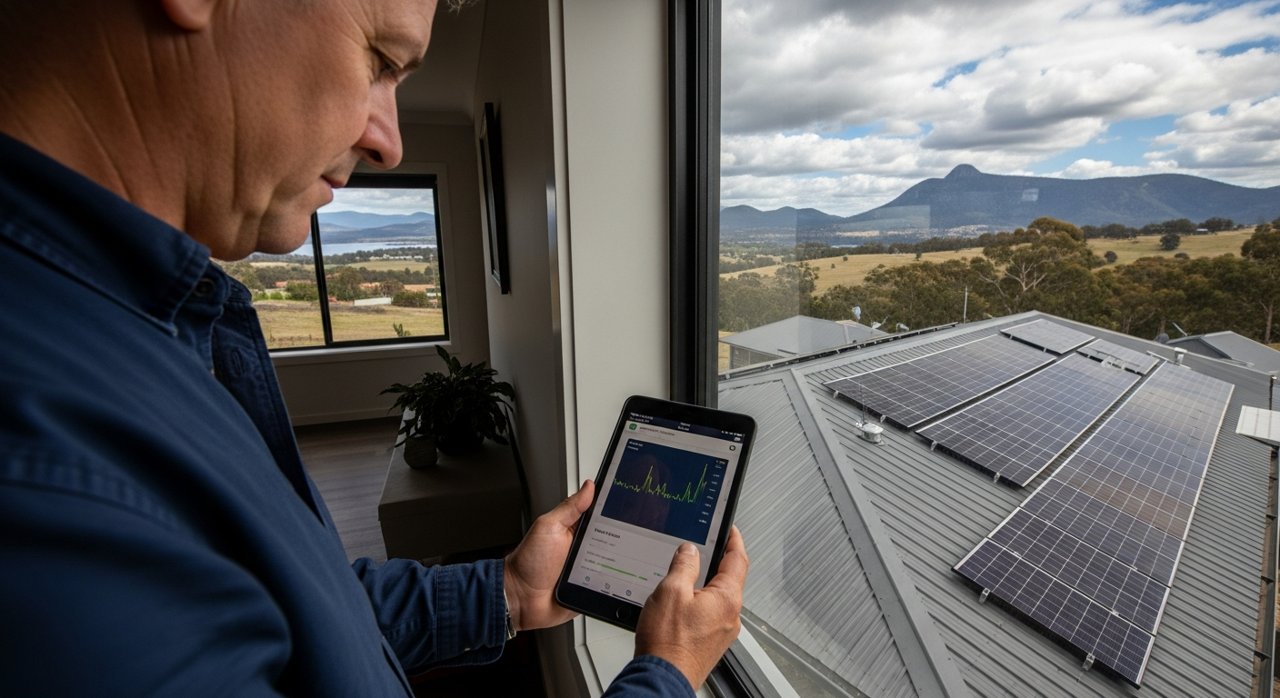
You’ve done the research, chosen your panels and inverter, and your new solar system is sitting proudly on your roof. The hard part’s over, right?
Mostly, yes. But to get the best bang for your buck over the next 20-plus years, it pays to understand what your system is doing day-to-day. Modern solar comes with easy-to-use monitoring apps for your phone or computer. Keeping an eye on these is the key to maximising your savings and spotting any potential issues early.
Here’s a plain-language guide to what you should be watching, and why it matters for your Tasmanian household.
Production vs. Consumption: The Daily Dance of Energy
Every solar monitoring app will show you two main things: how much power your panels are producing and how much power your home is consuming. These are usually shown as live graphs that change throughout the day.
- Production (Your Solar Generation): This is the power your panels are creating from sunlight. It will look like a curve, starting low in the morning, peaking around midday, and dropping off in the afternoon. On a clear, sunny day, it’ll be a smooth, bell-shaped curve. On a cloudy day, it will look spikier and lower as clouds pass over.
- Consumption (Your Home’s Usage): This is the power your appliances are using. It will be a much more erratic line, spiking up when you boil the kettle, run the washing machine, or use the heat pump, and staying low overnight.
The goal is to have the production curve sitting as high as possible above your consumption line during the day. That gap between the two is your free, self-generated power.
Why Self-Consumption is King in Tassie
This is the most important concept for Tasmanian solar owners to grasp. The savings are in using your own power, not selling it back to the grid.
Here’s why: with Aurora Energy, you might pay around 25-29 cents for every kilowatt-hour (kWh) of electricity you import from the grid. But for any excess solar you export, the regulated feed-in tariff is only around 9.3 c/kWh.
Every kWh of your own solar you use saves you the full 25-29 cents you would have paid. Every kWh you export only earns you a fraction of that.
Your monitoring app will often show your “self-consumption” or “self-sufficiency” percentage. This tells you how much of the power you used came from your own roof. The higher this number, the better your payback will be. A realistic payback period for a well-managed solar system in Tasmania is roughly 4-6 years.
Shifting Your Load: The Secret to Big Savings
Watching your app helps you get into the rhythm of your home’s energy use. You’ll quickly see when you are generating lots of free power. The trick is to move your big energy-using tasks into that solar window (usually from about 10 am to 4 pm).
- Run the dishwasher after breakfast, not after dinner.
- Put the washing machine and dryer on during the middle of the day.
- Charge your electric vehicle during the day.
- If you have a heat pump hot water system, make sure its heating cycle is timed for the middle of the day.
This “load shifting” costs you nothing but makes a huge difference to your power bills by maximising that all-important self-consumption.
Sizing Your System for the Future
In the past, a 6.6kW system was the standard. But as Tasmanians move to electrify their homes with EVs, heat pumps, and induction cooktops, a larger system is becoming the smart default.
A system with around 13kW of panels on a 10kW inverter is a great, future-proof choice for most homes. This takes advantage of the Clean Energy Council’s rule allowing you to “oversize” your panel capacity by 133% relative to your inverter. This helps generate more power on overcast days and earlier in the morning and later in the afternoon.
Thankfully, TasNetworks allows a 10kW single-phase inverter for most residential properties, meaning you don’t need an expensive three-phase upgrade to get a decent-sized system. This larger system gives you more capacity to power your home and charge a battery, further boosting your self-sufficiency.
Of course, if you have a very low-use home with no plans to electrify, a smaller system might be more suitable. Honesty is key here.
What About Batteries?
Adding a battery changes the game. Your monitoring app will show a third element: power flowing into and out of your battery.
- During the day: You’ll see excess solar power (what you’re not using in the home) being used to charge the battery.
- In the evening: As the sun goes down, you’ll see the battery discharging to power your home, preventing you from having to import expensive power from the grid.
A battery dramatically increases your self-consumption, but it also adds to the cost. The payback period for the battery portion of a system is typically longer, around 7-12 years. Federal government programs like the Cheaper Home Batteries program can help reduce this upfront cost.
Spotting Problems: What to Look For
Your monitoring app is also your first line of defence if something goes wrong. Here are a few things to watch for:
- Zero production on a sunny day: This is a red flag. Check if your inverter has tripped or if there’s a fault light showing.
- One panel string is down: Some apps show production per “string” (a group of panels). If one string is consistently producing much less than another, it could indicate a problem with a panel or a connection.
- Sudden, unexplained drop in performance: If your system seems to be producing less than it used to under similar weather conditions, it might be worth getting it checked.
Don’t get obsessed with checking it every hour. A quick look once a day or every few days is plenty to understand your patterns and make sure everything is ticking along as it should.
Your Takeaway
Think of your solar monitoring app as the dashboard for your home’s power station. You don’t need to be an expert to use it. Simply watch the relationship between what you’re generating and what you’re using. By understanding this daily dance, you can shift your habits to use more of your own free power, which is the key to unlocking the biggest possible savings from your solar investment in Tasmania.
This guide was written by the team at Solar Generation Tasmania. We’re passionate about helping Tasmanians understand and embrace solar energy.
#solargentas #solargen #solargenerationtasmania
Published by Solar Generation Tasmania. General information current as at publication — rebates, tariffs and prices change, so confirm current figures before deciding.
Thinking about solar for your place?
Tell us a little about your home and a local Tasmanian installer will put together a free, no-obligation assessment — system, battery and the rebates you qualify for.
- Honest advice for Tasmanian conditions (Zone 4 sun, hydro grid)
- We apply every rebate you’re eligible for
- Local installers — not a mainland call centre
- SAA-accredited, with degree-qualified owners and 10+ years in tech & solar