
← Blog · 1 July 2026
North-Facing vs East/West Solar Panels at Tasmania's Latitude
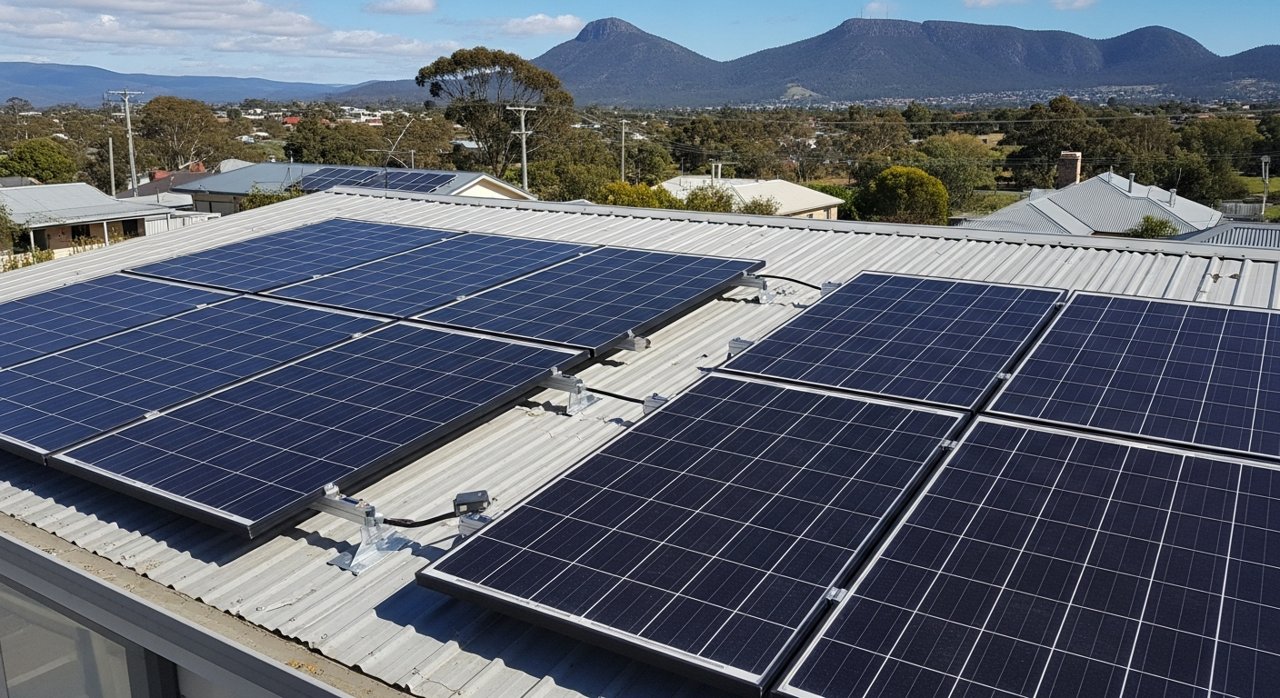
Deciding to go solar is a big step, and here in Tasmania, we have some unique factors to consider. One of the most common questions we hear is about the best direction to face your solar panels. For years, the standard advice across Australia was simple: “Face them north.” But is that still the best advice for a Tasmanian household in the 2020s?
The answer isn’t a simple yes or no. The best orientation for your panels—be it north, east, west, or a combination—depends entirely on how and when your household uses electricity. Let’s break down the options.
The Classic North-Facing Array: Maximum Generation
A north-facing solar array is the traditional setup for a reason. In the Southern Hemisphere, pointing panels north captures the most sunlight across the entire day, generating the maximum possible amount of energy (kilowatt-hours, or kWh) over a full year.
- How it works: It produces a classic “bell curve” of power. Generation starts slowly in the morning, ramps up to a strong peak in the middle of the day (roughly 10 am to 3 pm), and then tails off in the afternoon.
- Best for: Households where someone is home during the day. If you run a home office, have a young family, or are retired, a north-facing system is fantastic. You can run the dishwasher, washing machine, and other appliances during that midday peak, using the solar power as it’s generated. This is called “self-consumption.”
Self-consumption is the key to solar savings in Tasmania. Our main electricity retailer, Aurora Energy, pays a modest feed-in tariff (around 9.3 c/kWh) for power you export to the grid. But the price you pay to buy that same power back from the grid is much higher (around 25-29 c/kWh). Therefore, every kilowatt-hour of solar you use yourself saves you nearly three times what you’d earn by exporting it. A north-facing system gives you a powerful block of energy in the middle of the day to do just that.
The East/West Split: A Modern Approach for Modern Lifestyles
An east/west orientation is exactly what it sounds like: some of your panels face east to catch the morning sun, and the rest face west to catch the afternoon sun.
- How it works: Instead of a midday peak, an east/west system produces a broader, flatter generation curve. You get a surge of power in the morning as the sun rises, a slight dip in the middle of the day, and another strong surge in the late afternoon as the sun sets.
- Best for: Households that are empty during the day. If everyone is out at work or school, a big midday peak of solar power from a north-facing system is largely wasted. It gets exported to the grid for a small return. An east/west system, however, generates power when you’re most likely to be home: getting ready in the morning (boiling the kettle, making toast) and coming home in the afternoon (turning on lights, cooking dinner, watching TV).
This approach is designed to maximise self-consumption for the typical 9-to-5 household, generating power at the start and end of the day when demand is often highest. While it might generate slightly less total energy over the year than a perfectly north-facing array, the energy it does produce is often more valuable because you’re more likely to use it yourself.
So, Which is Right for a Tasmanian Home?
At Tasmania’s higher latitude, the sun sits lower in the sky, especially in winter. This makes the angle of your panels important. But the direction is about your lifestyle.
Ask yourself this simple question: When do we use the most power?
- High daytime use? If you’re home during the day, have an electric vehicle (EV) charging in the garage, or a heat pump running to warm the house, a north-facing system is likely your best bet. It will generate the most power possible to offset that significant daytime consumption.
- Morning and evening rush? If your home’s energy use spikes before 9 am and after 4 pm, an east/west system is a brilliant solution. It targets these high-use periods, helping you avoid buying expensive grid power when you need it most.
It’s also worth noting you can have both. Some homes have roof spaces that allow for panels facing north, east, and west, giving them the best of all worlds.
Sizing Your System for the Future
In the past, a 6.6kW system was the standard. Today, with Tasmania’s push towards electrification, that’s changing. Many households are now installing larger systems, and for good reason.
A 13kW system (that’s 13kW of panels paired with a 10kW inverter, which is the maximum size TasNetworks allows on a standard single-phase connection) is becoming the new default for a future-proof home. This might sound big, but it accounts for future additions like:
- An electric vehicle (EV)
- A heat pump for hot water
- An induction cooktop
- A home battery
Even if you don’t have these yet, sizing your system for them now is far cheaper than adding more panels later. The federal STC rebate, which gives a point-of-sale discount on your system, is calculated on the total panel capacity. Tasmania is in STC Zone 4. Getting a larger system from the start maximises this benefit.
A system of this size makes the orientation question even more interesting. With so much capacity, an east/west system can still produce plenty of power in the middle of the day, while a north-facing system will generate so much in its peak that it can charge a home battery and run the house.
Speaking of batteries, while the payback period is longer (around 7-12 years compared to 4-6 years for panels), they are a game-changer for self-consumption. A battery allows you to store that cheap midday solar energy and use it in the evening, completely avoiding peak grid prices. The federal Cheaper Home Batteries program can also help reduce the upfront cost.
The Takeaway
There is no single “best” direction for solar panels in Tasmania. The right choice is the one that matches your family’s unique rhythm of life.
- North-facing: Best for maximum annual generation and households with high energy use during the middle of the day.
- East/West-facing: Best for maximising self-consumption in homes where energy use is concentrated in the mornings and afternoons.
Before you decide, look at your power bills or use your smart meter data to understand when you use electricity. That knowledge is the key to designing a solar system that will save you the most money for years to come.
This guide was written by the local team at Solar Generation Tasmania. We’re always happy to help our fellow Tasmanians understand their solar options.
#solargentas #solargen #solargenerationtasmania
Published by Solar Generation Tasmania. General information current as at publication — rebates, tariffs and prices change, so confirm current figures before deciding.
Thinking about solar for your place?
Tell us a little about your home and a local Tasmanian installer will put together a free, no-obligation assessment — system, battery and the rebates you qualify for.
- Honest advice for Tasmanian conditions (Zone 4 sun, hydro grid)
- We apply every rebate you’re eligible for
- Local installers — not a mainland call centre
- SAA-accredited, with degree-qualified owners and 10+ years in tech & solar