
← Blog · 15 October 2026
REC Solar Panels in Foggy Tasmania: Do Premium Panels Earn Their Keep?
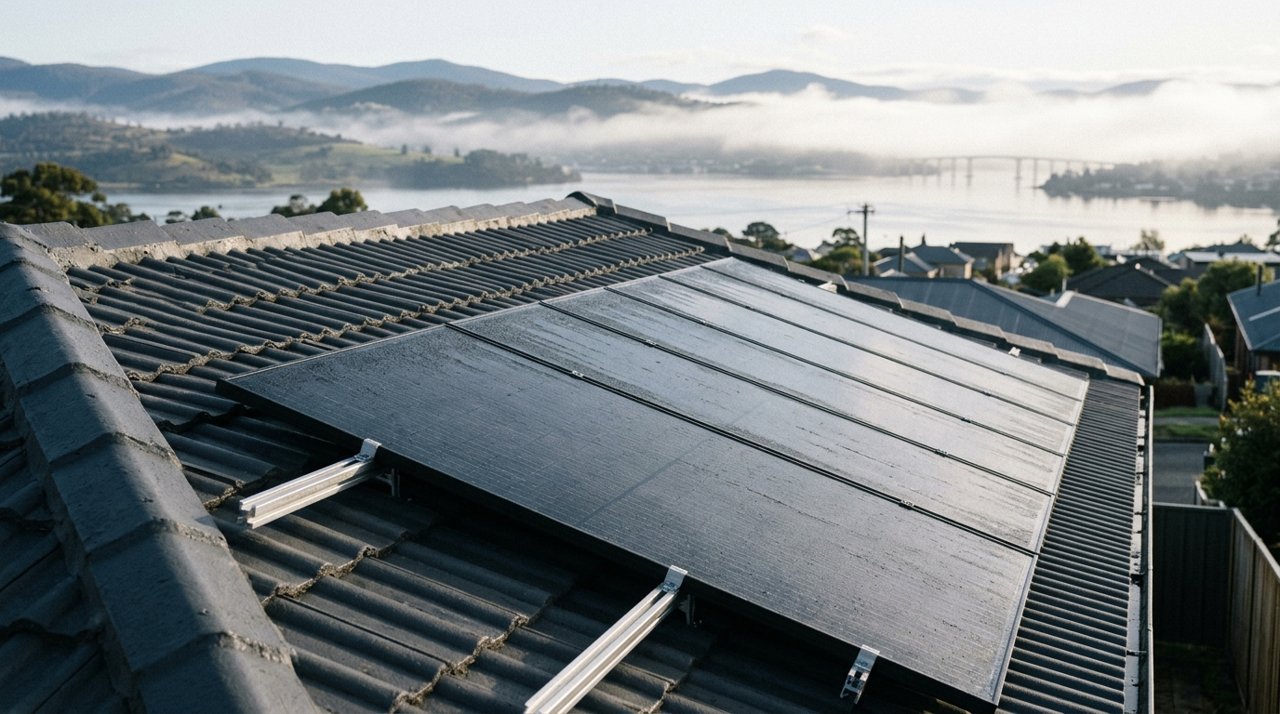
Tasmania is not Queensland. Our mornings fog in, our winters are long and low-lit, and our power is relatively cheap compared with the mainland. So when a quote lands with a premium panel on it — REC’s Alpha Pure-RX, say — the fair question is whether the extra spend does anything useful on a Tasmanian roof, or whether that money is better put into more panels, or a battery.
Here’s an honest look, with no sales pitch attached.
Do premium panels actually make sense in Tasmania’s climate?
Sometimes — and it depends far more on your roof than on your postcode. Premium panels earn their keep when roof space is tight, when shade or fog patterns are complex, or when long product and labour cover matters to you. On a big, clear, simple roof, price per watt and the quality of the installation usually matter more.
That’s the short answer. The rest is the detail behind it.
What makes the REC Alpha Pure-RX different from a standard panel?
It’s a large-format residential panel rated up to 470 W with up to 22.6% module efficiency, according to REC’s datasheet figures as republished by SolarQuotes and Clean Energy Reviews. The cells are n-type heterojunction (HJT) — crystalline silicon layered with amorphous thin-film — in a gapless, lead-free design.
In plain terms: more watts squeezed into each panel, and a different cell recipe to the commodity PERC panels that make up much of the budget end of the market.
| REC Alpha Pure-RX | Typical commodity PERC panel | |
|---|---|---|
| Cell technology | n-type heterojunction (HJT), gapless, lead-free | p-type PERC |
| Module efficiency | up to 22.6% (REC datasheet) | generally lower — check the datasheet |
| Power temperature coefficient | −0.24%/°C | about −0.34 to −0.40%/°C (industry datasheet comparisons) |
| Product warranty | 20 years standard; 25 years under REC ProTrust, conditions apply | commonly shorter — ask to see it in writing |
Will REC panels really perform better in fog and overcast light?
REC and independent reviewers attribute strong diffuse-light and overcast performance to HJT’s amorphous silicon layers and the gapless cell layout. That’s a manufacturer and reviewer characteristic, though — not a measured Tasmanian result. No published fog-yield figure for a Tasmanian home exists, and we won’t invent one.
If you live where fog sits — the Derwent Valley, parts of the Huon, Midlands mornings — it’s reasonable to care about diffuse-light behaviour. Just treat it as one design factor among several. Your actual losses depend on your site: how long the fog holds, which way your roof faces, and what trees or hills sit in the way. A good designer should talk about all of that, not just the panel sticker.
Does Tasmania’s cool climate cancel out the heat advantage?
Partly, yes — and that’s worth saying out loud. The Alpha Pure-RX’s power temperature coefficient of −0.24%/°C means it loses less output in heat than commodity PERC panels at roughly −0.34 to −0.40%/°C. That advantage is biggest on hot roofs.
Tasmania has fewer scorching days than the mainland, so the heat benefit is real but smaller here. It still shows up on a dark-tiled roof in a Hobart heatwave, or on a tight roof where panels sit close to the deck with little airflow. It’s just not the headline reason to choose a premium panel in Tasmania.
What does REC’s warranty actually cover?
REC’s performance warranty commits to at least 98% of nameplate output in year one, degradation of no more than 0.25% per year after that, and at least 92% of rated output at year 25. Standard cover is 20-year product and 25-year performance (REC warranty fact sheet; SolarQuotes’ warranty deep-dive).
The upgrade worth understanding is REC ProTrust, which lifts that to 25-year product, performance and labour — but only where the system is installed by a REC Certified Solar Professional and registered with REC. Labour cover runs 25 years for systems up to 25 kW, 10 years for 25–500 kW, and larger systems aren’t eligible.
Labour cover is the quietly valuable bit. A replacement panel is one cost; getting someone back on your roof to fit it is another.
Who owns REC, and does that matter over 25 years?
It matters, because a 25-year warranty is only as good as the company standing behind it. REC was founded in Norway in 1996. Its operational headquarters and cell and module factory are in Singapore, and it has been wholly owned by India’s Reliance Industries since October 2021, in a US$771 million acquisition reported by pv magazine.
Reliance sold REC’s Norwegian polysilicon unit to Elkem in 2024; the panel business stayed with Reliance. REC also maintains an Australian office for local warranty support (Energy Matters). None of that makes a claim easy or hard — but a local presence and a large parent company are reasonable things to check for any brand you’re trusting for decades.
How does my Tasmanian tariff change the decision?
More than the panel brand does. Aurora Energy is the main residential retailer, and the regulated feed-in tariff is modest — 9.276 c/kWh from 1 July 2026, up from about 8.8c — against a retail import price of roughly 28–30 c/kWh. Self-consumption, not export, is where household value sits.
Which tariff you’re on shapes when that self-consumption counts:
- Tariff 93 (residential time-of-use) is the default — every new or upgraded residential connection has been assigned to it since 1 July 2024. Whole-of-home, peak on weekdays 7–10am and 4–9pm (8–11am and 5–10pm during daylight saving), everything else off-peak, including all weekend.
- Tariff 31 (flat general light and power) and Tariff 41 (separately metered lower flat rate for hard-wired heating and hot water) are the legacy pair, closed to new installations on 30 June 2024. Existing homes may stay on them. Neither is time-of-use.
- Tariff 97 is the newer opt-in residential consumer-energy-resources tariff for homes with solar, a battery or an EV. It’s the only one with a super off-peak rate — midnight to 4am every day, weekends included — with peak on weekdays 7–10am and 4–10pm (an hour longer in the evening than Tariff 93), all other times off-peak, and an excess demand charge above 8.5 kW. Whether you can get a Tariff 97 retail plan depends on your retailer.
What size system should I be thinking about?
For most Tasmanian homes that will electrify — EV, heat pump, induction cooktop — around 13kW of panels on a 10kW inverter is the sensible, future-proof default, using the 133% inverter oversizing rule. TasNetworks allows a 10kW single-phase inverter here, so most homes don’t need three-phase.
That’s a step up from the old 6.6kW habit. The federal STC rebate under the SRES discounts the upfront cost, and Tasmania sits in STC Zone 4. Be realistic in the other direction too: a very low-use household with no battery, EV or electrification plans may genuinely suit something smaller.
And here’s where panel choice bites. If your usable roof can’t fit 13kW of ordinary panels, a higher-efficiency panel can be the difference between the system you want and the system that fits. That’s premium panels earning their keep in the most concrete way there is.
Should I put the extra money into a battery instead?
Often that’s the more interesting trade-off. The federal Cheaper Home Batteries Program, running since 1 July 2025, takes around 30% off an eligible battery — roughly $250 per usable kWh in 2026 at the full rate for the first 14 kWh, then 60% for 14–28 kWh and 15% for 28–50 kWh, capped at 50 kWh. It tapers each year to 2030, the battery must be paired with solar, and eligibility depends on the equipment and install meeting the program’s rules.
There’s no separate Tasmanian state battery rebate. And we’d rather be straight with you: Tasmania’s relatively cheap power and fair feed-in tariff mean the battery portion of a system generally pays back more slowly here than on the mainland. No vendor or retail VPP program operates in Tasmania, though wholesale-price exposure does exist through spot-passthrough retailing — and automated battery control can charge when spot prices go negative and avoid peak-period imports. Solar Generation runs exactly that on its own systems.
For a typical Aurora-tariff household without spot exposure, the value of a battery is self-consumption plus backup when the power goes out. Worth having, often — but go in with clear eyes, and judge solar and battery as two separate decisions rather than one bundled promise.
The practical takeaway
If you’re weighing a premium panel in Tasmania, these are the questions that actually change the outcome:
- Is your roof tight? If high efficiency is what gets you to a sensible system size, the premium is doing real work.
- Ask for the datasheet, not the brochure. Check the temperature coefficient, the module efficiency and the warranty terms yourself.
- If ProTrust matters to you, confirm the conditions in writing — installed by a REC Certified Solar Professional, registered with REC, and within the system-size limits for labour cover.
- Check your tariff before you size anything. Whether you’re on 93, a legacy 31/41, or looking at opting into 97 changes when your solar is worth the most.
- Weigh workmanship as heavily as the panel. A premium panel fitted poorly will disappoint you; a sound panel fitted well rarely does.
Premium panels aren’t a trick, and they aren’t magic. They’re a tool that suits some Tasmanian roofs very well and others not especially — and knowing which you’ve got is most of the decision.
This guide is part of a free community knowledge resource on Tasmanian solar, written by the Tasmanian solar team at Solar Generation Tasmania. We’re always happy to answer questions from locals working through this.
#solargentas #solargen #solargenerationtasmania
Published by Solar Generation Tasmania. General information current as at publication — rebates, tariffs and prices change, so confirm current figures before deciding.
Thinking about solar for your place?
Tell us a little about your home and a local Tasmanian installer will put together a free, no-obligation assessment — system, battery and the rebates you qualify for.
- Honest advice for Tasmanian conditions (Zone 4 sun, hydro grid)
- We apply every rebate you’re eligible for
- Local installers — not a mainland call centre
- SAA-accredited, with degree-qualified owners and 10+ years in tech & solar