
← Blog · 25 June 2026
Solar and EV Charging in Tasmania: Sizing for the Future
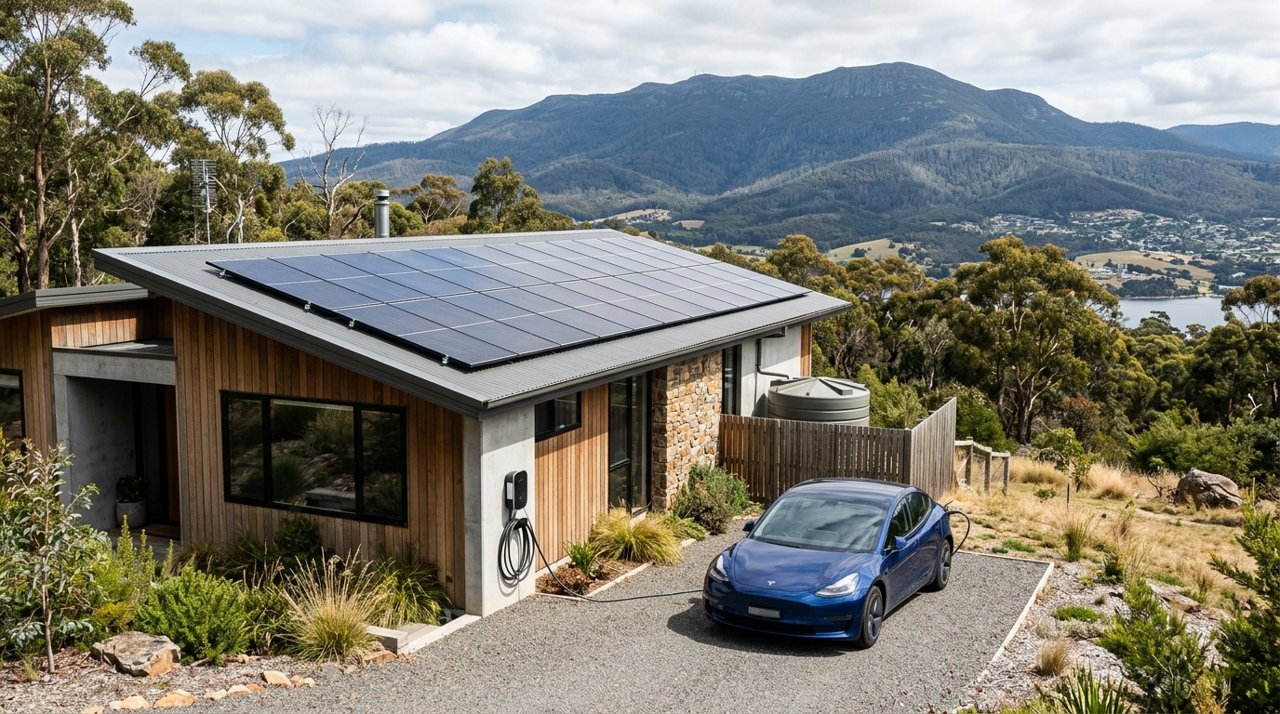
Thinking about solar for your Tassie home? It’s a brilliant move, but the game has changed. A few years ago, it was all about selling your excess power back to the grid. Now, with Aurora Energy’s feed-in tariff sitting around 9.3 cents per kilowatt-hour (c/kWh) and the cost to buy that same power back at roughly 25-29 c/kWh, the maths is simple. The biggest savings come from using your own solar power as it’s generated. This is called ‘self-consumption’, and it’s the key to unlocking the real value of your system.
Every kilowatt-hour of solar you use yourself is a kilowatt-hour you don’t have to buy. That’s a direct saving of nearly 30 cents. Every kilowatt-hour you export only earns you about 9 cents. This is why shifting your energy use to the daytime – running the dishwasher, washing machine, or heat pump when the sun is shining – makes such a huge difference to your power bills.
Sizing for Tomorrow: Why 6.6kW is Yesterday’s News
For years, the “standard” solar system size across Australia was 6.6 kilowatts (kW). It was a great starting point, but times are changing. Tasmanian households are electrifying. We’re swapping out old gas heaters for efficient heat pumps, replacing gas cooktops with induction, and, most significantly, we’re starting to drive electric vehicles (EVs).
Each of these changes adds to your home’s electricity demand. An EV, for example, can easily double a typical home’s daily power usage. A 6.6kW system that was perfect a few years ago will quickly become undersized for a modern, all-electric home.
This is why we now see a ~13kW system as the smart, future-proof default for most Tasmanian homes. This usually involves installing about 13kW of solar panels connected to a 10kW inverter. This might sound like a lot, but it gives you the headroom to power your home, your hot water, and your car, all from the sun.
A fantastic rule in Tasmania is that our network operator, TasNetworks, allows a 10kW inverter on a standard single-phase connection, which most homes have. This is a larger limit than in many mainland states and lets us build robust, future-ready systems without needing an expensive three-phase power upgrade.
The ‘133% Rule’ and Getting More from Your Inverter
You might wonder how you can put 13kW of panels on a 10kW inverter. This is a standard industry practice called “oversizing,” and it’s particularly effective in Tasmania. Solar panels rarely operate at their full peak capacity due to weather, clouds, and the angle of the sun.
By oversizing the panel array by up to 133% of the inverter’s capacity (a limit set by the Clean Energy Council), you allow the inverter to run at its most efficient level for more of the day. It will start producing meaningful power earlier in the morning and keep going later in the afternoon. While on a perfect, blue-sky summer day, the output might be momentarily capped or “clipped” at 10kW, the extra energy you gain on the shoulders of the day and during overcast weather far outweighs this small loss.
What About a Battery?
With self-consumption being so important, a home battery seems like the obvious next step. A battery lets you store your excess solar energy from the daytime and use it in the evening, slashing your reliance on the grid even further.
The honest truth is that while the payback for solar panels is typically a very attractive 4-6 years, the payback for a battery is longer, often in the 7-12 year range. However, the new federal Cheaper Home Batteries program, which started in mid-2025, can significantly reduce the upfront cost. This program provides a rebate based on the battery’s size, which can take thousands off the initial price.
Our advice? Size your solar panel system for the future, even if you don’t install a battery on day one. A large solar array will ensure you have plenty of excess generation to charge a battery when you decide the time is right.
How an EV Changes Everything
An electric vehicle is essentially a big battery on wheels. The average EV uses about 7-8 kWh of energy to cover the typical daily commute. Adding this to your household consumption makes a larger solar system a necessity if you want to charge it with clean, free energy.
A 13kW system is perfectly sized for this. On a good day, it can power your home’s daytime needs, charge your EV, and still have energy left over to store in a home battery or export to the grid. Charging your car from the sun is the ultimate way to reduce your transport costs and your carbon footprint.
Is Bigger Always Better?
For most households looking to electrify, yes. But we believe in being honest. If you’re a very low-energy user, you don’t plan on getting an EV or a heat pump, and you’re home during the day to use the power as it’s generated, a smaller system of 5-8kW might be all you need. The goal is to match the system to your life, both now and in the future.
Your Takeaway
When planning for solar in Tasmania, think beyond your current electricity bill. Consider what your home will look like in five years. Will you have an EV? A heat pump? Sizing your system for that future now is the most cost-effective way to prepare. A generous 13kW of panels on a 10kW inverter is the new sweet spot for the average Tassie home, giving you the power to run your life on sunshine for years to come.
This guide was written by the team at Solar Generation Tasmania. We’re a local crew passionate about helping Tasmanians understand their energy options.
#solargentas #solargen #solargenerationtasmania
Published by Solar Generation Tasmania. General information current as at publication — rebates, tariffs and prices change, so confirm current figures before deciding.
Thinking about solar for your place?
Tell us a little about your home and a local Tasmanian installer will put together a free, no-obligation assessment — system, battery and the rebates you qualify for.
- Honest advice for Tasmanian conditions (Zone 4 sun, hydro grid)
- We apply every rebate you’re eligible for
- Local installers — not a mainland call centre
- SAA-accredited, with degree-qualified owners and 10+ years in tech & solar