
← Blog · 5 October 2026
Tasmania as the Battery of the Nation: What It Means for Your Home and How to Benefit
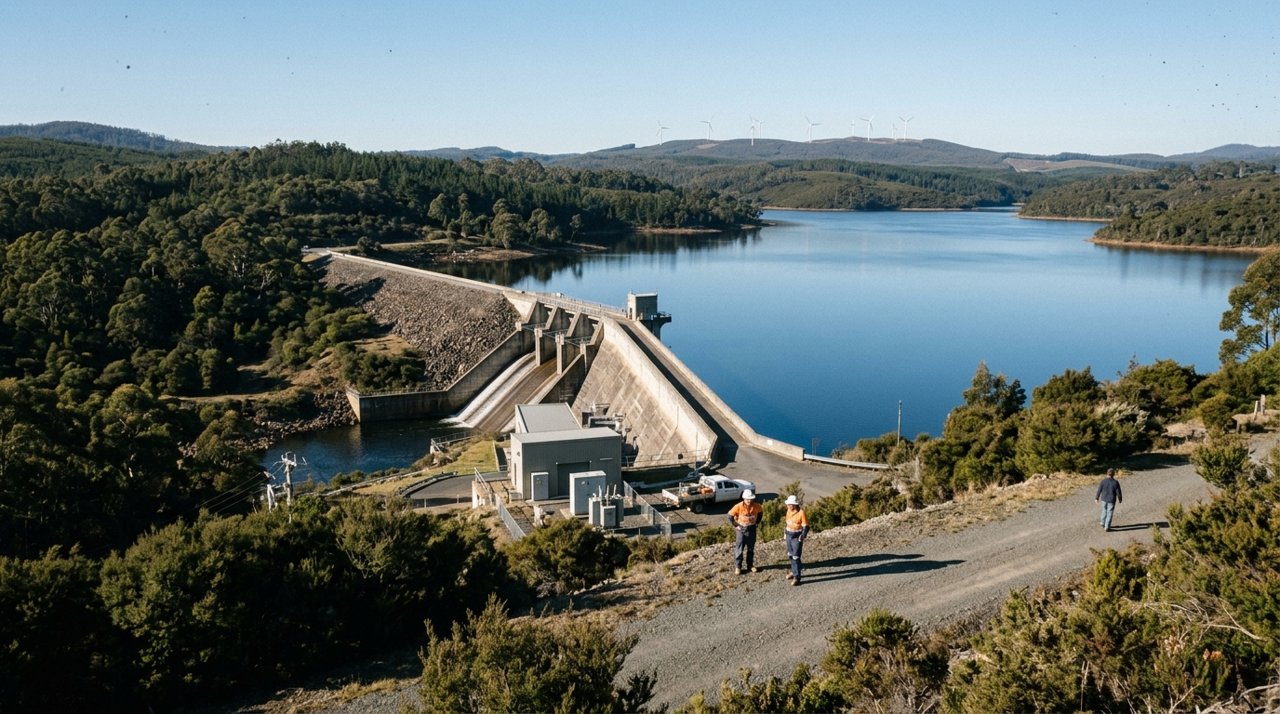
Tasmania’s “Battery of the Nation” push — pumped hydro, Marinus Link and grid upgrades — is about big energy infrastructure, but it quietly changes the economics of your home solar, battery and EV choices too. Here’s what’s actually happening, and how an ordinary household can benefit.
What is the “Battery of the Nation” plan?
It’s a Hydro Tasmania vision and a set of projects, not one funded scheme — and that distinction matters when you read headlines. Hydro Tasmania’s 2018 study with ARENA identified 4,800 MW of pumped-hydro potential across 14 priority sites in Tasmania. The idea: use Tasmania’s hydro system and new pumped storage to bank renewable energy and send it north when the mainland needs it.
The pieces moving now include Marinus Link (the new Bass Strait cable), the Tarraleah rebuild, the proposed Cethana pumped-hydro scheme, and upgrades to Tasmania’s own north-west grid. Tasmania’s legislated Renewable Energy Target is 150% of the state’s baseline electricity needs by 2030 (15,750 GWh in a year) and 200% by 2040 (21,000 GWh). Renewables already supplied 97.5% of Tasmania’s generation in calendar 2025, with hydro at 71.8%.
What is Marinus Link and when does it happen?
Marinus Link is a new undersea cable to Victoria that reached final investment decision on 1 August 2025. Stage 1 is a single 750 MW cable, 345 km long — 255 km under Bass Strait and 90 km underground in Gippsland — targeted to be in service in 2030 (AEMO’s 2026 Integrated System Plan lists June 2030, with full capacity in December 2030). A second 750 MW stage is not committed.
The ownership and cost split:
- Owners: Commonwealth 49%, Victoria 33.3%, Tasmania 17.7%
- Cable costs: shared between customers — Tasmanian customers 27.6%, Victorian customers 72.4% (Tasmanian Treasury)
- North-west transmission upgrades: these fall on Tasmanian customers
In February 2026 the Australian Energy Regulator approved $3,470.6m for the cable and $921.3m for the North West Transmission Developments. Meanwhile, the existing Basslink cable (500 MW, owned by APA Group) became a regulated network asset from 1 July 2026, with the regulator allowing $459.5m of revenue for 2026–30.
Will Marinus Link make my power bill cheaper or dearer?
Honestly, nobody can promise either — credible analyses point both ways. The Tasmanian Government’s own business case (April 2025) estimated Marinus Stage 1 plus the north-west upgrades add about $70 a year (about 3%) in transmission charges to a typical $2,200 bill, which it said would be broadly offset by lower wholesale prices than without the link. A study commissioned by Marinus Link (FTI Consulting, July 2025) estimated a typical household would be about $113 a year better off. Other analysis argues that tying Tasmania more tightly to the mainland market could push local prices up.
What we do know: network charges already drive Tasmanian bills. Aurora Energy’s standing offer rose 4.23% on 1 July 2026, and the regulator said higher network charges were almost all of that rise. The ABC reported the north-west transmission decision adds about $15.50 a year from 2026, rising to about $49 a year from 2029, before offsets.
Does Tasmania really run on renewables all the time?
Mostly, but not always — and dry years are the weak point. In 2024–25 the Tasmanian Economic Regulator reported hydro at 72.9%, wind 21.1% and gas 3.3%, with rooftop solar exports about 2.7%. That year was the driest in 20 years of records, and Tasmania imported a net 1,967 GWh over Basslink — the largest net import since 2008–09. In dry years, the state leans on the mainland.
What about the big hydro projects?
- Tarraleah: a rebuild of a 90 MW hydro scheme into about 190 MW. Hydro Tasmania’s May 2025 business case put it at $1.96bn (2024 dollars), up from $700m in 2022. The first tender stage launched in March 2026; there’s no final investment decision yet.
- Cethana pumped hydro: a proposed 750 MW scheme with about 20 hours of storage, still in environmental approvals, with no published cost and no final investment decision. AEMO’s 2026 plan still lists it as being investigated.
How does all this affect my home solar?
More than you might think. Tasmania’s wholesale spot price (the TAS1 region) usually tracks Victoria’s through Basslink and diverges when the cable is constrained — in the June 2026 quarter Tasmania averaged $86/MWh against $56/MWh in Victoria (AEMO). Tasmanian wholesale prices also go negative at times: Solar Generation’s analysis of AEMO’s public TAS1 5-minute data found about 7.7% of intervals were negative in August 2026 and about 21.5% in September 2026 (to the 23rd).
For a household, the practical takeaway is simple: self-consumption, not export, is where the savings are. The regulated feed-in tariff is modest — 9.276 c/kWh from 1 July 2026, up from about 8.8c — while importing power costs roughly 28–30 c/kWh. Every kWh of your own solar you use in your home is worth about three times what exporting it earns.
What size solar system should I get?
For most homes planning to electrify — EV, heat pump, induction cooking — a system around 13kW of panels on a 10kW inverter (using the 133% inverter oversizing rule) is the sensible, future-proof default, a step up from the old 6.6kW standard. TasNetworks allows a 10kW single-phase inverter in Tasmania, so most homes don’t need three-phase. The federal STC rebate (SRES) discounts the system cost; Tasmania is STC Zone 4.
Be honest with yourself, though: a very low-use home with no battery, no EV and no electrification plans may suit a smaller system. Payback for solar is commonly quoted at roughly 4–6 years in Tasmania, but actual results depend on your usage, tariffs and system — treat any figure as a guide, not a promise.
Which tariff should I be on?
This matters as much as panel choice:
- Tariff 93 (residential time-of-use) is the default — since 1 July 2024 every new or upgraded residential connection is assigned to it. Peak is weekdays 7–10am and 4–9pm (8–11am and 5–10pm during daylight saving); everything else, including all weekend, is off-peak.
- Tariff 31 (flat-rate light and power) and Tariff 41 (separately metered, lower flat rate for hard-wired heating and hot water) are the legacy pair — closed to new installations on 30 June 2024, though existing homes can stay on them. Neither is time-of-use.
- Tariff 97 is the new opt-in tariff for homes with solar, a battery or an EV. It’s the only one with a super off-peak rate (midnight–4am every day, including weekends), its peak is weekdays 7–10am and 4–10pm (an hour longer in the evening than Tariff 93), and it carries an excess demand charge above 8.5 kW. Availability depends on your retailer — Aurora Energy is the main residential retailer.
Is a home battery worth it in Tasmania?
With the federal Cheaper Home Batteries Program (from 1 July 2025) taking about 30% off an eligible battery — roughly $250 per usable kWh in 2026 at the full rate for the first 14 kWh, then 60% for 14–28 kWh and 15% for 28–50 kWh, with a 50 kWh cap — batteries are more affordable than they were. The discount tapers each year to 2030, and the battery must be paired with solar. There is no separate Tasmanian state battery rebate.
Being straight with you: Tasmania’s relatively cheap power and fair feed-in tariff mean a battery typically pays back more slowly here than on the mainland — the battery portion is often quoted at around 7–12 years, though this varies. For a typical Aurora-tariff household, the value is self-consumption plus outage backup. No vendor or retail VPP program operates in Tasmania, but wholesale-price exposure does exist through spot-passthrough retailing: a battery can automatically charge when spot prices are very low or negative and avoid buying at expensive times. Solar Generation runs exactly this on its own systems. Spot plans carry price risk, though, and don’t suit everyone.
How do I actually benefit, starting this week?
- Use your own solar — run the dishwasher, washing machine and heat pump in daylight hours rather than exporting for 9.276c.
- Shift big loads — hot water, EV charging and heating into daylight or cheap periods (Tariff 97’s midnight–4am super off-peak suits overnight EV charging).
- Consider a battery with the federal discount if outages or evening peaks bite — it stores your own solar for the evening peak and keeps the lights on.
- Check your tariff — if you’re on a legacy Tariff 31/41 setup, compare it against Tariff 93 and, if you have solar or an EV, ask your retailer about Tariff 97.
The big Battery of the Nation projects will play out over the next decade. But the “battery of the nation” that matters most for your bill is the one on your own roof — and the best time to start using it better is today.
This guide is written by the Tasmanian solar team at Solar Generation Tasmania — a free community resource, and we’re always happy to answer questions if you’d like to chat.
#solargentas #solargen #solargenerationtasmania
Published by Solar Generation Tasmania. General information current as at publication — rebates, tariffs and prices change, so confirm current figures before deciding.
Thinking about solar for your place?
Tell us a little about your home and a local Tasmanian installer will put together a free, no-obligation assessment — system, battery and the rebates you qualify for.
- Honest advice for Tasmanian conditions (Zone 4 sun, hydro grid)
- We apply every rebate you’re eligible for
- Local installers — not a mainland call centre
- SAA-accredited, with degree-qualified owners and 10+ years in tech & solar