
← Blog · 30 July 2026
The Cheaper Home Batteries Program Explained for Tasmanians — A 2026 Guide
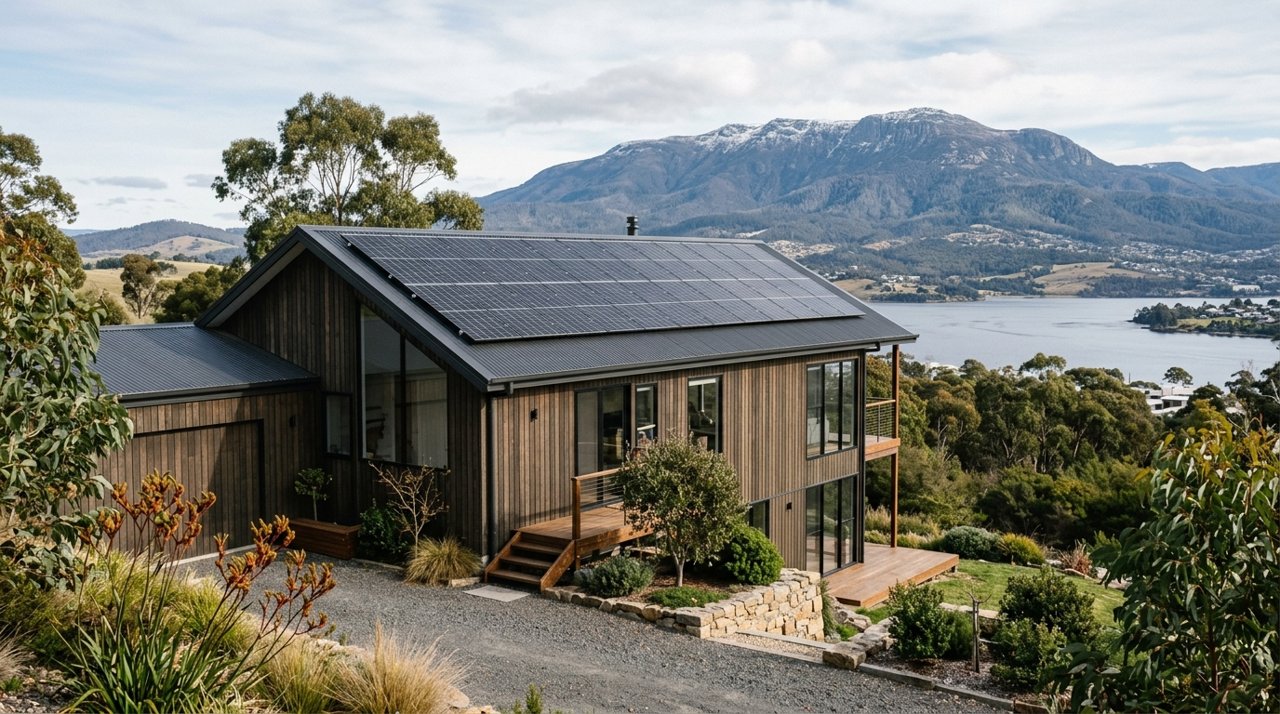
Yes, for most Tasmanian households, installing solar panels is a smart financial decision. The key is to use the power you generate yourself, because the price you pay for electricity from the grid (your ‘import’ rate) is much higher than the credit you get for sending your excess solar power back to the grid (your ‘feed-in tariff’). By using your own solar power during the day, you directly reduce the amount of expensive electricity you need to buy.
The savings come from avoiding buying power from your retailer, which costs around 28-30 cents per kilowatt-hour (c/kWh). In contrast, the solar feed-in tariff from Aurora Energy is regulated and sits at a more modest 9.276 c/kWh from 1 July 2026. This difference means every kilowatt-hour of solar you use yourself saves you roughly three times more than exporting it. With a well-sized system, many Tasmanian homes can see the system pay for itself in electricity savings in roughly 4 to 6 years.
How does the federal battery rebate work for Tasmanians?
The Australian Government’s Cheaper Home Batteries Program can significantly reduce the upfront cost of a new solar battery if you meet the eligibility criteria. From 1 July 2025, this program offers a discount on eligible battery systems that are installed alongside new or existing solar panels. There is no separate Tasmanian state government rebate, so this federal program is the main financial support available.
The discount is structured to provide more support for the initial capacity of the battery. For an eligible system in 2026, you might receive a discount of around $250 per usable kilowatt-hour (kWh) for the first 14kWh of battery capacity. The support rate changes for larger batteries and is expected to taper down each year until the program ends. It’s important to remember that eligibility is not guaranteed and depends on meeting the program’s specific requirements.
Should I get a battery with my solar panels?
Adding a battery is a great way to maximise your self-consumption, but it does extend the payback period for your investment. A battery allows you to store the excess solar power you generate during the day and use it in the evening, instead of exporting it for a small credit and then buying expensive grid power after the sun goes down. This is where the real value lies for Tasmanians.
However, batteries are still a significant additional cost. While a solar-only system might pay for itself in 4-6 years, adding a battery could push the payback period for the battery component out to 7-12 years, even with the federal rebate. The other major benefit of a battery is blackout protection, providing backup power during outages, which can be a valuable feature for many households. Unlike on the mainland, opportunities to earn income from your battery by participating in a Virtual Power Plant (VPP) are not really a factor in Tasmania’s hydro-dominated grid.
Here’s a quick comparison to help you decide:
| Getting a Battery Now | Waiting to Add a Battery |
|---|---|
| ✅ Maximise self-consumption by using stored solar power at night. | ✅ Lower upfront cost for your solar installation. |
| ✅ Gain energy independence and backup power during grid outages. | ✅ Shorter payback period for the initial solar panel investment. |
| ✅ Take advantage of the 2026 Cheaper Home Batteries Program discount. | ✅ Battery technology is still improving and prices may come down further in the future. |
| ❌ Longer overall payback period for the combined system. | ❌ You’ll still be buying expensive grid power every evening and on cloudy days. |
| ❌ Significant extra upfront cost compared to a solar-only system. | ❌ You may miss out on the current federal rebate if it changes or ends. |
What size solar system should I get?
For a typical Tasmanian home looking to future-proof for things like an electric vehicle (EV), a heat pump for hot water, and maybe an induction cooktop, a larger system of around 13kW of panels paired with a 10kW inverter is becoming the new standard. This might sound big, but it’s designed to cover your future, higher electricity usage as you electrify your home.
TasNetworks, our grid operator, allows for a 10kW inverter on a standard single-phase connection, which most Tasmanian homes have. This avoids the significant cost and complexity of upgrading to a three-phase connection. The industry standard practice of ‘oversizing’ the panels by up to 133% of the inverter’s capacity (e.g., 13.3kW of panels on a 10kW inverter) helps generate more power on overcast days and during the shoulders of the day, maximising your energy production throughout the year.
Of course, not everyone needs a system this large. If you have a smaller home, very low electricity usage, and no plans to get an EV or electrify your appliances, a smaller system like the old 6.6kW standard might be a more suitable and cost-effective option for your circumstances.
How do government solar rebates work in Tasmania?
The main upfront discount on the cost of solar panels comes from the federal government’s Small-scale Renewable Energy Scheme (SRES). This isn’t a cash rebate you receive later, but an upfront discount that your installer claims on your behalf, reducing the price you pay.
The scheme works by creating Small-scale Technology Certificates (STCs) based on the size of your solar system and your location. Tasmania is in STC Zone 4. A larger system in Zone 4 creates a certain number of these certificates. The value of these STCs fluctuates with market demand, but your installer will typically factor a fixed dollar value into your final quote, saving you thousands of dollars on the total cost of the system. This federal incentive applies to the solar panels, not the battery.
Ultimately, the decision to go solar, and whether to include a battery, depends on your household’s energy use, future plans, and budget. The key in Tasmania is to focus on a system size that allows you to use as much of your own generated power as possible, as this is where the greatest financial savings are found.
This guide was written by the local team at Solar Generation Tasmania to help our community make informed energy decisions.
#solargentas #solargen #solargenerationtasmania
Published by Solar Generation Tasmania. General information current as at publication — rebates, tariffs and prices change, so confirm current figures before deciding.
Thinking about solar for your place?
Tell us a little about your home and a local Tasmanian installer will put together a free, no-obligation assessment — system, battery and the rebates you qualify for.
- Honest advice for Tasmanian conditions (Zone 4 sun, hydro grid)
- We apply every rebate you’re eligible for
- Local installers — not a mainland call centre
- SAA-accredited, with degree-qualified owners and 10+ years in tech & solar