
← Blog · 16 October 2026
Why Big Solar Companies Struggle to Deliver Bespoke Systems
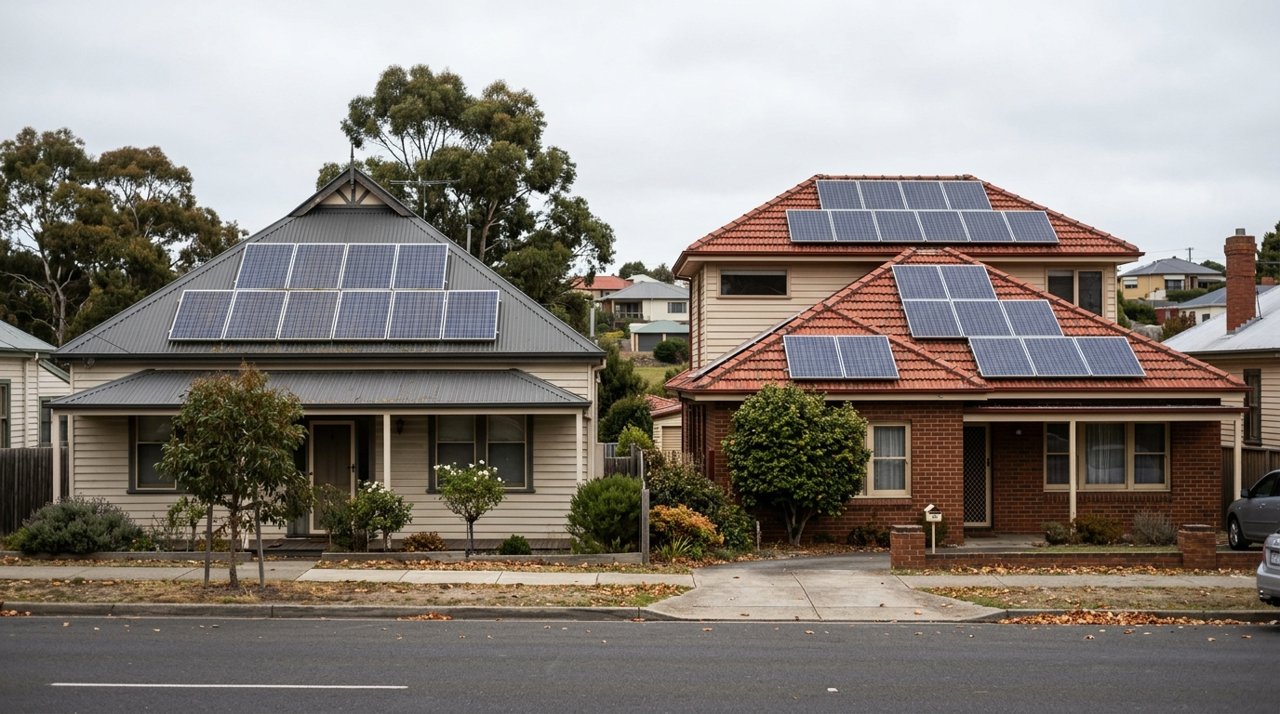
Buying rooftop solar in Tasmania is one of the few home decisions where the design matters more than the brand on the box. And yet most quotes that land in Tasmanian inboxes look oddly similar. There’s a structural reason for that, and it’s worth understanding before you sign anything.
Why does my solar quote look exactly like my neighbour’s?
Because most advertised systems are packages, not designs. SolarQuotes notes that panels are currently rated around 440 W, so the familiar 6.6 kW package works out to roughly 15 panels covering about 30 square metres of roof. That’s a one-size-fits-most product built to be quoted in minutes — not a layout worked out for your roof, your tariff and the way your household actually uses power.
Packages aren’t dishonest. They’re efficient. Our view is simply that scale rewards repetition: when a business sells high volume, standard sizes, phone quoting and subcontracted crews are the rational way to run it. Bespoke design pulls the other way, because someone qualified has to stop and look at your particular site.
Is the person who quotes my job the same person who installs it?
Often, no — and that’s the single most useful thing to understand about this industry. Accreditation in Australia is personal, not corporate. Solar Accreditation Australia (SAA) accredits individual installers and designers, not companies. As energy.gov.au puts it: “The accreditation is for the person, not the company.”
The Clean Energy Regulator approved SAA as the scheme operator on 29 February 2024, and since late May 2024 claims for small-scale technology certificates on new systems require SAA accreditation.
So “accredited company” is a looser claim than it sounds. The meaningful question is which accredited person designed your system, and which accredited person will be on your roof.
Is subcontracting allowed, and what should I expect on the day?
Yes, it’s normal and permitted. energy.gov.au’s installation guidance acknowledges that the retailer who sells you the system may subcontract the installation to a different company. What the guidance does set out is where the accredited installer must physically be present:
- at set-up
- for a mid-installation check
- for testing and commissioning
- and ideally for the whole job
It also gives you a simple, practical check for installation day: confirm that the panels and inverter actually delivered match the ones named on your quote or contract. Not the equivalent. The named ones.
What does the federal rebate actually require?
The federal STC rebate reduces the up-front cost of a system, and Tasmania sits in STC Zone 4. But it’s conditional, and the conditions are about who and what: according to energy.gov.au, the system must be installed by an SAA-accredited installer and use panels and an inverter listed on the Clean Energy Council’s approved product lists.
That matters for substitutions. If the gear that turns up isn’t what was specified, you’re not only getting a different system — you may be affecting whether the job meets the rebate conditions. Eligibility always depends on your installation meeting the scheme’s requirements at the time.
The same conditional logic applies to batteries. The federal Cheaper Home Batteries Program, which began on 1 July 2025, takes roughly 30% off an eligible battery, tapers each year to 2030, and requires the battery to be paired with solar. There’s no separate Tasmanian state battery rebate.
Why does a site visit change the design and the price?
Because the expensive surprises live in the parts of your house nobody can see over the phone. energy.gov.au advises getting at least three quotes and asking for a site visit, precisely because a visit picks up switchboard, roof-access, inverter-location and shading issues that change both the design and the cost.
| What a phone quote assumes | What a site visit finds |
|---|---|
| Switchboard is ready to go | Older board may need upgrading before connection |
| Simple roof access | Steep pitch, limited access, scaffolding needs |
| Clear sun all day | Shading from gums, chimneys, a neighbour’s roofline |
| Inverter goes “on the wall” | Cable-run length, heat, noise, where it’s sensible to live with |
| A standard panel count fits | Your roof planes and orientation say otherwise |
In Tasmania these aren’t edge cases. Plenty of Hobart and Launceston homes are older, on sloping blocks, with mature trees and switchboards that predate the idea of a rooftop generator.
Why does standardisation hurt a Tasmanian household in particular?
Because here the value is in self-consumption, and self-consumption depends on your tariff — which a standard package never looks at. The regulated feed-in tariff rises to 9.276 c/kWh from 1 July 2026, up from about 8.8c, while importing power costs roughly 28–30 c/kWh. Electricity you use yourself is worth far more than electricity you export.
Which tariff you’re on then shapes everything:
- Tariff 93 (residential time-of-use) is the default — since 1 July 2024 every new or upgraded residential connection is assigned to it. It’s whole-of-home, with peak on weekdays 7–10am and 4–9pm (8–11am and 5–10pm during daylight saving); everything else, including all weekend, is off-peak.
- Tariff 97 is the newer opt-in residential CER tariff for homes with solar, a battery or an EV. It’s the only one with a super off-peak rate (midnight–4am every day, weekends included), its peak runs weekdays 7–10am and 4–10pm — an hour longer in the evening than Tariff 93 — all other times are off-peak, and it carries an excess demand charge above 8.5 kW. Whether a Tariff 97 retail plan is available to you depends on your retailer.
- Tariffs 31 and 41 are the legacy pair, closed to new installations on 30 June 2024. Existing homes may remain on them. Neither is time-of-use.
A designer who knows your tariff will think differently about panel orientation, inverter sizing and whether a battery earns its keep. For most households planning to electrify — EV, heat pump, induction — around 13 kW of panels on a 10 kW inverter (the 133% oversizing rule) is a sensible future-proof default, and TasNetworks allows a 10 kW single-phase inverter, so three-phase usually isn’t needed. A genuinely low-use home with no battery, EV or electrification plans may be better off smaller. A package can’t make that call for you.
Be realistic about batteries here, too. Solar generally pays for itself faster than the battery portion does, and Tasmania’s comparatively cheap power and fair feed-in tariff slow battery returns relative to the mainland. No vendor or retail VPP program operates in Tasmania, though wholesale-price exposure does exist via spot-passthrough retailing, and automated control can charge when spot prices go negative and avoid peak imports — we run exactly that on our own systems. For a typical Aurora-tariff household without spot exposure, the value is self-consumption plus backup during outages.
So are small installers always better?
No — and this is where we’d push back on our own argument. Small can be careless and big can be excellent. Size isn’t the test. The test is whether a qualified person designs for your actual site, and whether someone stays accountable to you after the invoice is paid.
energy.gov.au also suggests buying from sellers approved under the New Energy Tech Consumer Code (NETCC), who commit to consumer-protection standards across sales, quotes, contracts, installation, warranties and support.
What’s the practical takeaway?
Ask three questions, and judge the answers rather than the brochure:
- Who is the SAA-accredited person on this job — the designer, and the installer — and will they be here for set-up, the mid-job check and commissioning?
- Will someone come and look at my roof, switchboard, shading and meter box before quoting a size?
- What’s your reasoning for this size and layout given my tariff, my usage pattern and what I plan to add in the next five years?
Then, on installation day, match the panels and inverter against the contract before the crew packs up. Get at least three quotes. Check NETCC approval. Keep every document.
A system designed around your roof and your tariff will quietly outperform a standard package for the next twenty-odd years. It just takes an extra fortnight of patience at the start.
This free community guide is written by the Tasmanian solar team at Solar Generation Tasmania, who are always happy to answer a question from a fellow Tasmanian.
#solargentas #solargen #solargenerationtasmania
Published by Solar Generation Tasmania. General information current as at publication — rebates, tariffs and prices change, so confirm current figures before deciding.
Thinking about solar for your place?
Tell us a little about your home and a local Tasmanian installer will put together a free, no-obligation assessment — system, battery and the rebates you qualify for.
- Honest advice for Tasmanian conditions (Zone 4 sun, hydro grid)
- We apply every rebate you’re eligible for
- Local installers — not a mainland call centre
- SAA-accredited, with degree-qualified owners and 10+ years in tech & solar